Yes, but not in the way most people expect. Solar produces most of its power in summer and a heat pump uses most of its power in winter, so panels will not run your heating through January. What they do well is cover most of your electricity from spring to autumn, and paired with a battery and a cheap overnight tariff they bring down the cost of winter as well.
Why heat pump demand and solar output rarely line up
An air-source heat pump takes heat from the outside air and moves it into your radiators and hot water cylinder, using electricity to run a compressor. Its efficiency is measured as a seasonal coefficient of performance, or SCOP. A SCOP of 3 means every 1 kWh (kilowatt hour, a unit of energy) of electricity delivers about 3 kWh of heat across the year.
Recent UK installations average a SCOP of around 3, and a well-designed system in a reasonably insulated home can reach 3.5 to 4. So a home that needs 12,000 kWh of heat a year would use roughly 3,000 to 4,000 kWh of extra electricity. For many households that is more than everything else in the house put together, and most of it arrives between November and March.
Solar output runs the other way. Averaged across the UK, each kW (kilowatt, the peak rated size of an array) of south-facing panels produces about 119 kWh in May and only about 29 kWh in December, according to the European Commission's PVGIS solar model. The months when your heat pump works hardest are the months when your panels produce least, and an honest design starts from that fact rather than from the annual total.
A worked example across the year
Take a home with an 8 kW south-facing array, a heat pump using 4,000 kWh of electricity a year, and 3,500 kWh a year of other household use, or about 290 kWh a month. Using the monthly PVGIS averages, the array produces about 7,590 kWh a year.
- January: the heat pump uses around 650 kWh and the house 290 kWh, a total of 940 kWh. The panels produce about 264 kWh. Even if every unit were used, solar would cover 28% of demand, leaving around 676 kWh to buy.
- April: the heat pump uses around 250 kWh, for a total of 540 kWh. The panels produce about 880 kWh, more than the home needs over the month, though much of it arrives while the heating is off.
- June: the heat pump only heats water, around 100 kWh, for a total of 390 kWh. The panels produce about 936 kWh, leaving a large surplus to store, divert or export.
On paper, 7,590 kWh of generation covers 7,500 kWh of annual demand. In practice, the winter shortfall is bought from the grid and the summer surplus is exported at a lower price than you pay to import. The monthly heat pump figures here are illustrative, and yours will depend on the house, the weather and the settings.
Sizing the array for spring and autumn
You cannot build a domestic array big enough to cover January, but you can make a real difference in the shoulder seasons. In March and October the heat pump is still running most days, and the same 8 kW array produces about 656 kWh and 488 kWh respectively. Every extra kW of panels adds around 82 kWh in March, exactly when you need it.
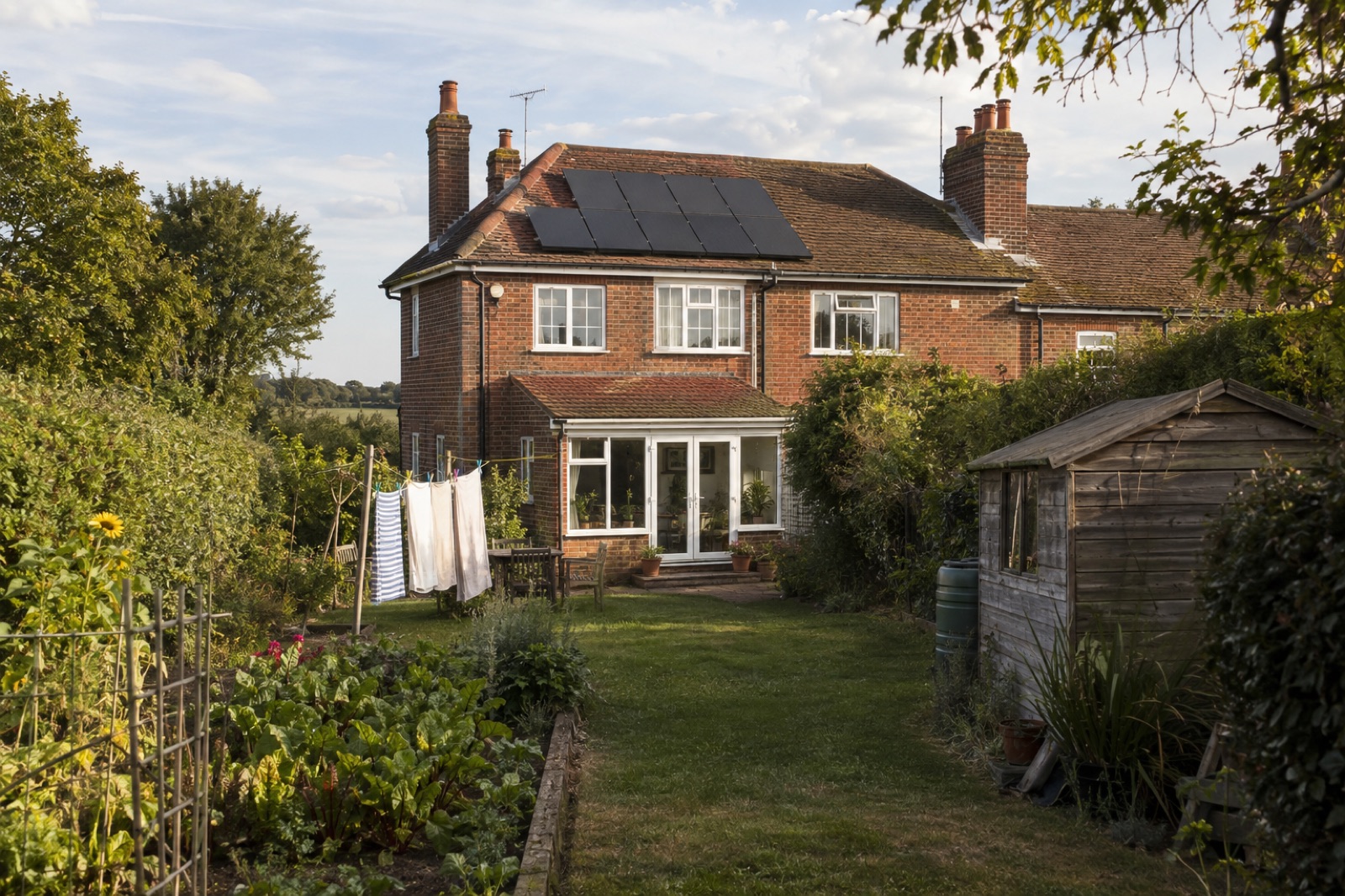
That is why we size heat pump homes differently. For a family in Sevenoaks replacing an oil boiler, we used both the main roof and the garage to reach 12 kW, with 28 panels of 430 W each. That is more than a typical home needs, but it matches the heat pump's spring and autumn demand, and from March to October the house ran almost entirely on its own generation. Roof space is usually the limit, so check whether your roof is suitable early on.
Batteries, overnight tariffs and hot water
A battery that works in both seasons
In summer a battery stores the midday surplus for the evening. In winter, when there is little surplus, it can charge overnight on a cheap tariff and run the heat pump through the expensive part of the day. At the time of writing, heat pump tariffs offer several cheaper windows a day at around 14 to 15p per kWh, and EV tariffs go as low as 6.5p to 10p overnight but are often limited to electric car owners. The price cap rate is around 26p. Our guide to whether a solar battery is worth it covers sizing in more detail.
In Sevenoaks, the 13.5 kWh battery charges on a cheap overnight tariff in winter and from the panels for the rest of the year. It cycled 310 times in its first year.
Hot water diverters
A hot water diverter sends surplus solar to the immersion heater in your cylinder before it is exported. With a heat pump the sums are closer than they look. An immersion heater turns 1 kWh of electricity into 1 kWh of heat, while the heat pump would make about 3 kWh from the same unit, so each kWh diverted saves only around a third of a kWh of heat pump electricity, roughly 9p at 26p per kWh. If your export tariff pays more than that, exporting can be worth more. A simple alternative is to schedule the heat pump's hot water cycle for the middle of the day, when the panels are strongest.
Honest winter expectations and the Boiler Upgrade Scheme
Winter bills will not disappear. The aim is to make the heat pump affordable in the coldest months and close to free for much of the rest of the year. Over its first winter, the Sevenoaks household's combined heating and electricity cost was 41% lower than the previous year's oil plus electricity, and its annual energy spend fell from £3,860 to £1,240. That is a large system on a house with a generous roof, so treat it as a strong result rather than an average.
The heat pump itself can be part-funded through the Boiler Upgrade Scheme in England and Wales. At the time of writing:
- Grant: £7,500 towards an air-source or ground-source heat pump.
- Off-gas uplift: an extra £1,500 until March 2027 if your home is heated by oil or LPG and has no mains gas connection, taking the grant to £9,000.
- Eligibility: you must own the property and be replacing oil, gas, LPG or electric heating. Most new builds and social housing are not eligible.
- How it is paid: your MCS-certified heat pump installer applies and takes the grant off the price.
The scheme does not fund solar panels or batteries. However, solar panels, batteries and heat pumps installed in homes are all currently zero-rated for VAT, until 31 March 2027.
Where to start
If you are planning a heat pump, design the solar around it rather than adding panels as an afterthought. The most useful things to bring to the conversation are your heat pump installer's predicted annual consumption and a year of electricity bills. For the financial side, see how to work out your solar payback.
We model month-by-month generation against your heat pump's demand before recommending an array size, and you can see how that worked in practice in our Sevenoaks case study. Find out more about solar for your home, or contact us to have your roof modelled.