Most roofs in London and the South East can take solar panels, and more of them are worth it than people expect. South-facing is best, but east- and west-facing roofs typically produce around 80% as much, and even a shallow north-facing slope can make sense. What usually rules a roof out is heavy shading, a covering that needs replacing soon, or too little usable space.
Orientation and pitch: realistic yields by direction
Solar output is judged against an ideal: an unshaded, south-facing roof at around 35 to 40 degrees. Using the European Commission's PVGIS model for south London, here is roughly what other roofs produce compared with that ideal:
- South at 30 to 45 degrees: 99 to 100%.
- South-east or south-west: about 95%.
- East or west at 35 degrees: about 78 to 80%.
- Low tilt of around 10 degrees, facing east, west or south: about 82 to 91%.
- North at 15 degrees: about 70%.
- North at 35 degrees: about 55%.
Pitch matters less than people assume. On a south-facing roof, anything between 30 and 45 degrees is within about 1% of the best, and most British pitched roofs fall in that range. Direction matters more, and shade matters most of all.
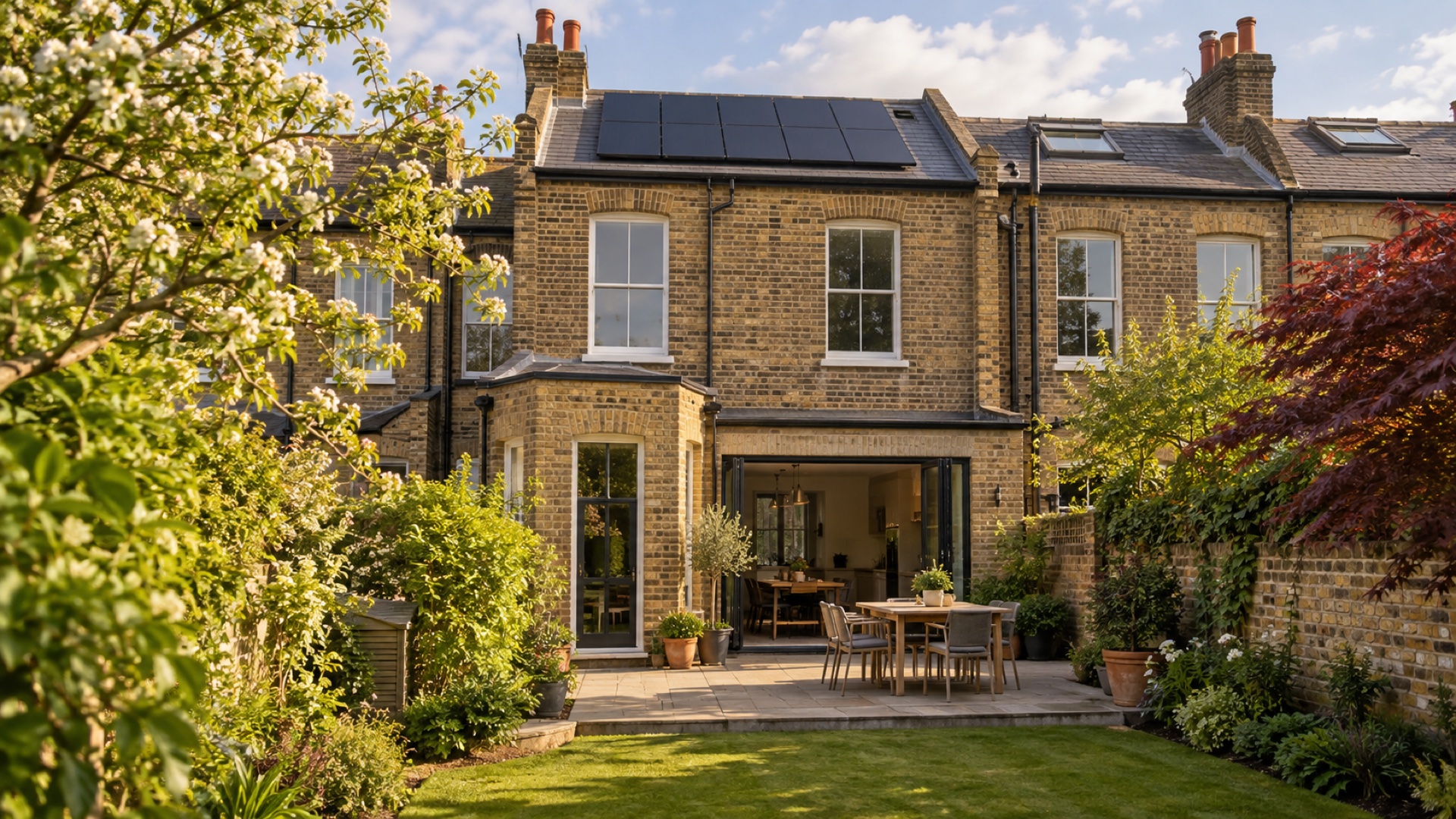
In our experience, well-designed systems in the South East produce roughly 850 to 1,000 kWh a year for each kW of panels. A kW (kilowatt) is the panels' peak rating, and a kWh (kilowatt hour) is the energy they actually produce. Our Dulwich terrace project produced 7,100 kWh from 8.2 kW in its first year, about 866 kWh per kW, from a south-south-west roof with some late-afternoon shade.
A worked example: one roof, three directions
Take a rear roof slope 8 metres wide and 5 metres from eaves to ridge. We leave about half a metre clear around the edges for wind loading and access, which leaves roughly 7 metres by 4 metres to work with. A standard 430 W panel measures about 1.72 by 1.13 metres, so in portrait you fit 6 across (6 × 1.13 = 6.78 metres) and 2 rows up (2 × 1.72 = 3.44 metres). That is 12 panels, or 12 × 430 W = 5.16 kW.
Using 950 kWh per kW as a planning figure for a good south-facing roof:
- Facing south: 5.16 × 950 = 4,902 kWh a year.
- Facing east or west (80%): 4,902 × 0.8 = 3,922 kWh a year.
- Facing north at 35 degrees (55%): 4,902 × 0.55 = 2,696 kWh a year.
The east or west roof still delivers four fifths of the south figure, and spreads it across the morning or evening, when many households use more power. The north roof is where we slow down and look hard at the numbers, because payback stretches out and a smaller system on a better slope may be the smarter choice.
Shading, and when optimisers help
Shade does more harm than a poor orientation. Panels are usually wired in strings (groups connected in series), and in a basic string system a shadow on one panel can pull down the output of the whole string. Chimneys, dormers, trees and taller neighbouring buildings are the usual culprits. A shadow that only falls in winter or late in the day matters far less than one across the middle of a summer day.
Where shade touches only a few panels, optimisers solve most of the problem. These are small units fitted behind each panel that let it work independently, so a shaded panel only affects itself. On the Dulwich terrace, a neighbour's chimney shades the roof in late afternoon, and optimisers mean the shadow only affects the two panels it falls on. Where a roof is shaded for most of the day, no electronics will rescue it, and we will tell you so.
Roof condition, structure and covering
Panels last 25 years or more, so the roof beneath them should too. If your tiles, battens or felt are close to the end of their life, it is far cheaper to replace them before the panels go on than to remove and refit the array later. We inspect the covering and the loft on every survey.
Structure is rarely the problem. A standard panel weighs about 21 to 23 kg, roughly 11 to 12 kg per square metre, which most sound pitched roofs carry comfortably. We still check rafter size and spacing, and occasionally recommend strengthening. The covering affects the method more than the answer:
- Concrete and clay tiles: the most straightforward, with hooks fixed to the rafters beneath the tiles.
- Natural slate: perfectly suitable but more fragile, so it takes more time and care, and sometimes a few replacement slates.
- Standing-seam metal: clamps grip the seams, so no holes are needed.
- Flat roofs: usually a ballasted frame, held down by weight rather than fixings. This adds load, so the structural check matters more, and the membrane should have plenty of life left.
In-roof or on-roof, and how much space you need
On-roof mounting fixes panels to rails a short distance above the existing tiles or slates. It is the standard, lower-cost option, and the air gap behind the panels keeps them cooler. In-roof mounting replaces a section of the roof covering, so the panels sit almost flush. It looks neater and is often preferred on period and sensitive buildings, but it costs more and the panels can run slightly warmer. It makes most sense when you are re-roofing anyway or when appearance matters, as it did on the Victorian terrace in Dulwich, where we fitted all-black in-roof panels to keep the rear slate roof looking tidy.
For space, allow roughly 4.5 square metres of usable roof per kW with modern 430 W panels. A 4 kW system needs about 18 square metres and an 8 kW system about 36. Hips, valleys, roof windows and vent pipes all eat into that, which is why we design on an accurate roof model rather than a rough area. Planning rarely stands in the way, but our guide to planning permission covers the exceptions.
Getting a proper assessment
You can do a rough check yourself. Note which way your main slopes face, watch what shades them through the day, and think about when the roof was last replaced. That will tell you whether solar is worth exploring. To understand what the panels do with the light once they are up there, read how solar panels work.
A real answer needs a survey. Our installation team measures the roof, models the shading across the year and checks the structure before we quote, so the yield figure is for your roof rather than an average. Book a survey and we will tell you honestly whether your roof is worth it.